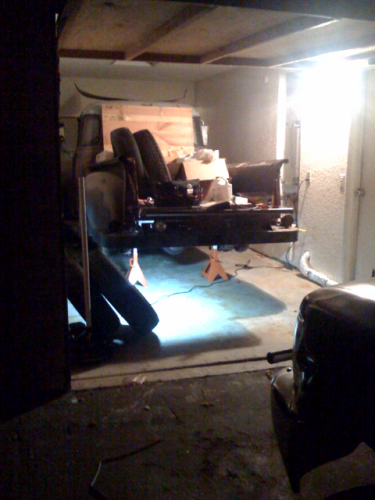
Tuesday, September 30, 2008
Master cylinder is in.


Wednesday, September 24, 2008
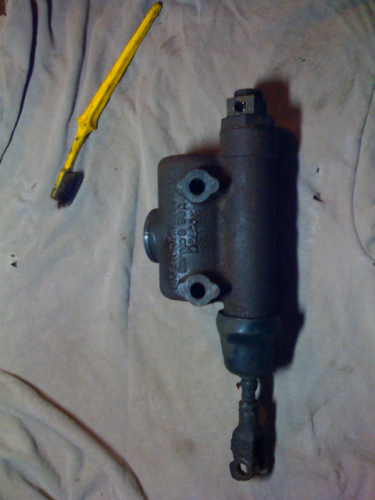
Well I finally made a little progress. I was able to pull the master cylinder out. Hopefully tomorrow at work I can use a vice to get the fill cap off. Tonight I am going to order a new cap and rebuild kit. It is going to be really nice to be able to go to work and use some equipment. I think one of my favorite things to use will be the parts washer. As soon as I gut this guy it will get cleaned up.
Uploaded by www.cellspin.net
Monday, September 22, 2008
Saturday, September 20, 2008
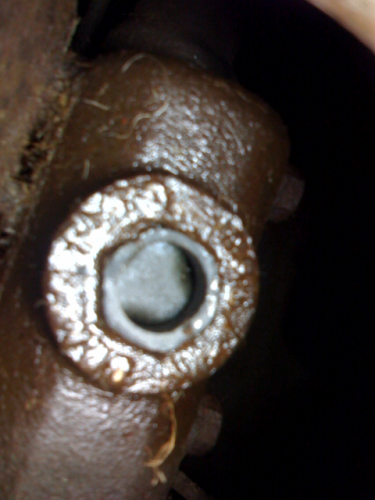
Sadly this is a counterproductive day. Trying to remove the fill cap on the mastercylinder I broke the cap. So if I can still get it off I can look for a replacement cap. If I can't I can look for a new mastercylinder. Sigh..
Uploaded by www.cellspin.net
Friday, September 19, 2008
More history
"Stovebolt" defined ish...
Stovebolt
From Wikipedia, the free encyclopedia
The term Stovebolt refers to a variety of inline-6 cylinder engines used in General Motors vehicles from the 1930s to early 1960s.
Stovebolt is also used to refer specifically to the Advance-Design series trucks with the 216 and 235 engines. These trucks were produced from mid 1947 to early 1955. In old Chevrolet truck restoration circles, these are referred to as 1947 second series trucks to 1955 first series trucks. The reason being that in 1947 they had the previous body style still being made, and in 1955 they had the newer body style coming out.
The reason the General Motors inline-6 cylinder engines were referred to as a Stovebolt was due to the engine's 1/4"x20 slotted-head bolts inside the engine. These bolts looked like the slotted-head bolts that were used on metal constructed wood burning stoves, hence the slang term or nickname of Stovebolt for the General Motors Inline Six cylinder engine.
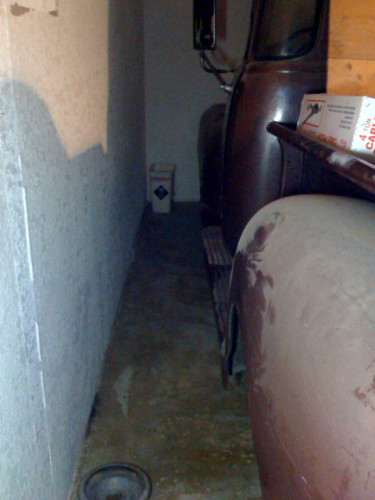
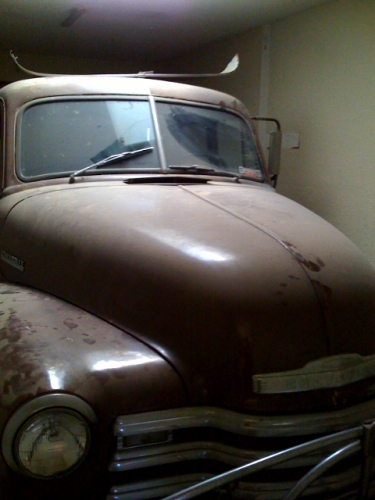
This looks cool. There is a skylight in my one-car garage. You can see I have a visor sitting on the roof. Maybe soon I can mount it.
Uploaded by www.cellspin.net